

Why It Matters
Your website should work for everyone. For state and local governments, the Department of Justice’s 2024 rule establishes web accessibility requirements based on WCAG 2.1 Level AA. For businesses and organizations, accessibility helps more people use your services and reduces avoidable barriers.
Learn more about the DOJ’s 2024 web accessibility rule:
Compliance Deadlines
State and local government websites must meet WCAG 2.1 Level AA under the DOJ’s Title II web accessibility rule.
April 26, 2027
Public entities serving 50,000+ people
April 26, 2028
Public entities serving under 50,000 people and special districts
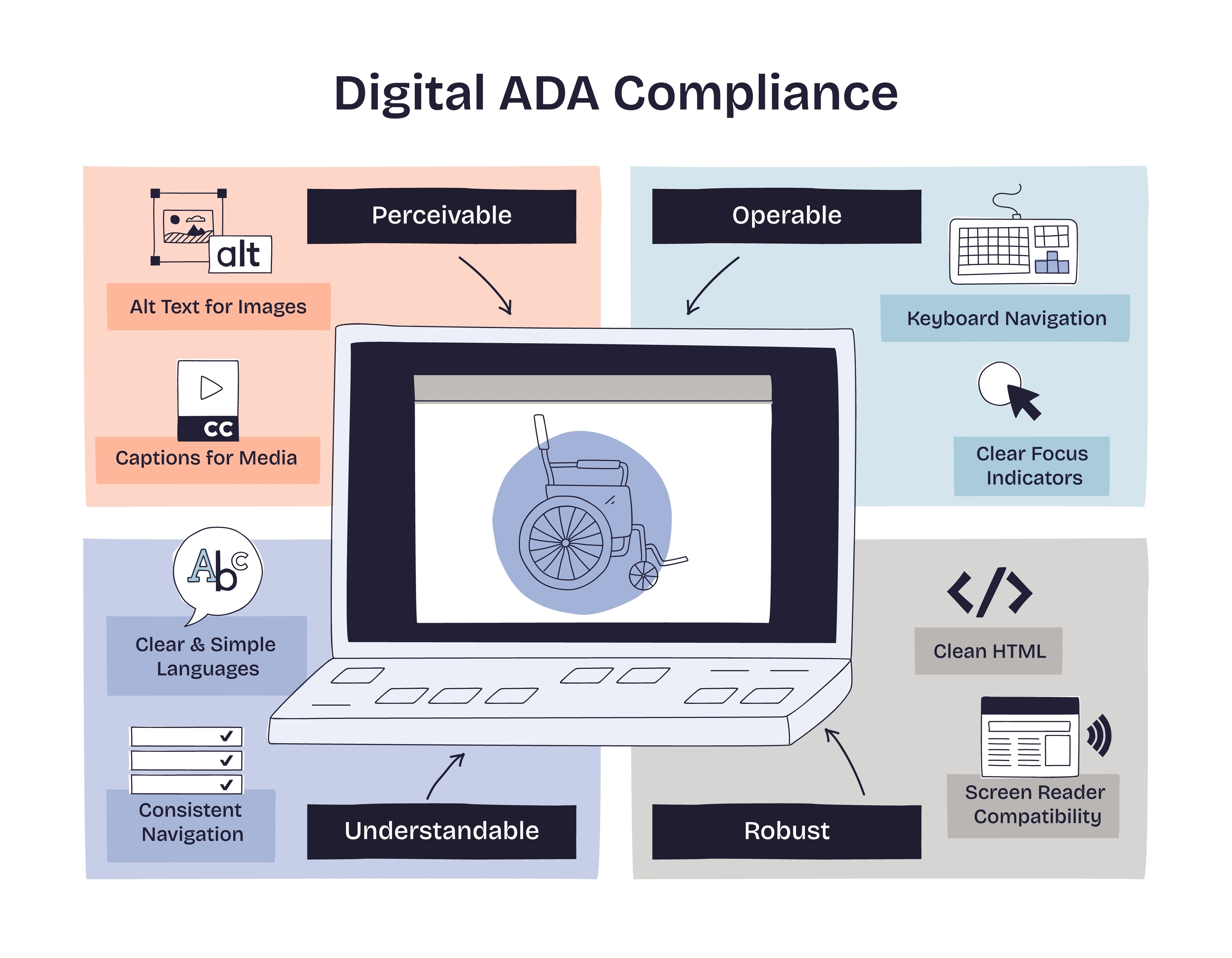
Accessibility Includes
What WCAG 2.1 AA covers on your site.
Web Design for Clerks
Everything your office needs to stay online and compliant.
See for yourself:Clerk Sites We've Built


Accessibility Doesn’t Stop at Launch
A website can become less accessible as new pages, images, forms, and documents are added. Ongoing monitoring helps catch those issues early and keeps your site moving in the right direction.
The Real FAQ's
Clerks of Court are covered by the U.S. Department of Justice’s ADA Title II web accessibility rule. The rule requires state and local government websites and mobile apps to meet WCAG 2.1 Level AA accessibility standards. In April 2026, the DOJ extended the original compliance dates by one year. Offices serving a total population of 50,000 or more must comply by April 26, 2027. Those serving fewer than 50,000 people, and special district governments, must comply by April 26, 2028. The technical standard itself did not change. In practice, residents who use screen readers, keyboard navigation, or other assistive technology must be able to find court information, search records, pay fees, and complete filings online without barriers.
In most cases, a rebuild is the cleaner, safer, and more cost-effective path to ADA compliance. Many older Clerk of Court websites run on outdated platforms, templates, or code that were never designed for WCAG 2.1 AA. Patching them means repeated fixes that can break with every update, and accessibility overlay widgets don’t make a site compliant on their own. A rebuild lets MODIPHY® build accessibility into the site from the ground up: semantic headings, keyboard-friendly navigation, accessible forms, proper contrast, and clear page layouts. The result is a website that’s easier for every resident to use, not just one that ticks a compliance box.
MODIPHY® works alongside i3 Verticals as the website partner for Clerk of Court clients. Your existing court systems stay in place. Your website continues connecting residents to the records, payments, filings, and other services your office already uses. MODIPHY® handles the public-facing website: accessibility, design, and ongoing support. Clear, accessible navigation also makes it easier for residents to reach the court services they need.
Accessibility is ongoing, not a one-time project. Every new page, PDF, image, or form added to a Clerk’s website can introduce new barriers, so WCAG compliance has to be maintained as content changes. MODIPHY® provides the continued support, updates, and upkeep needed to help keep your site accessible after launch. That keeps your office aligned with ADA Title II requirements through the 2027 and 2028 deadlines and beyond.
Yes. The ADA Title II rule covers the web content a Clerk of Court uses to provide services or information. That includes PDFs, fillable forms, court notices, fee schedules, and downloadable documents. Each one needs proper tagging, a logical reading order, alt text for images, labelled form fields, and enough colour contrast for assistive technology to read it. There are limited exceptions, such as archived content kept only for reference and certain documents posted before the compliance date. Those exceptions only apply if the documents aren’t currently used to apply for or access a service. Any form residents still rely on to file, request records, or pay fees must be accessible.
No problem. This is what we do. MODIPHY® makes a copy of your current Clerk of Court website, rebuilds it to WCAG 2.1 AA accessibility standards, and manages the full transition. Residents keep access to court information and online services throughout, with no disruption to your office. All we need is domain access and one point of contact at your office.
MODIPHY® does, through our on-demand support. When your office needs to post a notice, change office hours, update fees, or add a new form, send the change to our team and we handle it. Your staff doesn’t have to learn web software or become your own web department.
Very little. Website accessibility is MODIPHY®’s specialty. Our team handles the migration, rebuild, ADA accessibility work, launch, and ongoing website support and upkeep. All we need is one point of contact at your office, so your staff can stay focused on serving the public and the court.